


The 2026 FIFA World Cup arrived this summer across 16 host cities in the United States, Canada, and Mexico. While large-scale events such as the World Cup bring significant economic and cultural benefits there is strong evidence that human trafficking activity tends to increase around events of this size. Such events are not responsible for human trafficking, but they can create conditions in our communities that traffickers exploit.
For financial institutions, this concentration presents both heightened risk and an opportunity to demonstrate that effective anti-trafficking efforts require strategic intelligence capabilities, not merely compliance responses.
The FinCEN Notice: A Direct Regulatory Call to Action
In May, the Financial Crimes Enforcement Network (FinCEN) issued a Notice warning U.S. financial institutions of the increased risk of human trafficking connected to the 2026 FIFA World Cup. With millions of visitors expected across North America, FinCEN’s message is clear: while human trafficking is an ongoing threat, large-scale events can drive spikes in demand for labor and commercial sex – and traffickers move quickly to exploit these conditions.
Financial institutions, often one of the few points of contact outside of traffickers’ control, play a critical role in identifying and reporting this activity.
For financial institutions with mature risk management frameworks, the Notice reinforces and validates practices they already have in place rather than requiring reactive compliance responses. For institutions still developing their risk management capabilities, this Notice provides essential guidance and actionable tools to enhance their detection frameworks.
FinCEN outlines specific transactional and behavioral red flags, provides Suspicious Activity Report (SAR) filing guidance, and builds on prior advisories from 2014 and 2020, underscoring that this is a known, documented threat requiring a deliberate institutional response.
The Scale of Human Trafficking Globally
The scale of the problem underscores the urgency of this guidance.
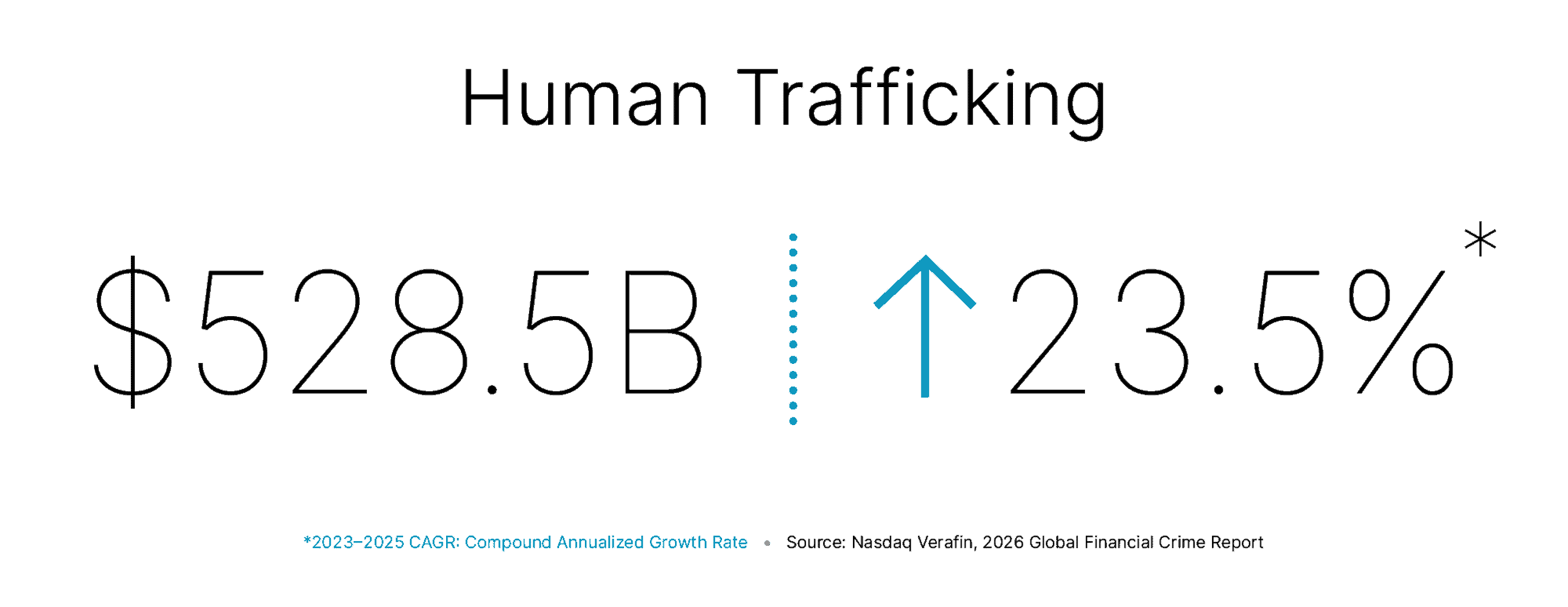
The Nasdaq Verafin 2026 Global Financial Crime Report estimates that human trafficking generated $528.5 billion in illicit proceeds in 2025, up from $346.7 billion in 2023, a compound annualized growth rate of 23.5%, making it the fastest-growing major crime typology in the Report. It also reflects a broader financial crime epidemic that now totals $4.4 trillion globally. Tens of millions of people are coerced into labor or sex trafficking at any given moment around the globe.
FinCEN’s Notice reinforces what many compliance and investigative teams already understand: financial institutions are essential partners in combating human trafficking. The guidance urges institutions to file SARs as soon as potential trafficking indicators emerge, regardless of traditional thresholds, and to notify law enforcement through established channels, including the National Human Trafficking Hotline.
The Notice also highlights why financial institutions are uniquely positioned to act. In many cases, victims may have little or no contact with the outside world beyond required financial interactions. Transactional behavior involving repeated travel‑related charges, rapid movement of funds, use of prepaid cards or P2P platforms inconsistent with a customer profile, can provide early insight into coercion or control before physical harm escalates.
Nasdaq Verafin’s Commitment to Detection
Effective detection involves understanding customer behavior over time, linking related entities, and sharing intelligence legally and responsibly across institutions. FinCEN explicitly encourages voluntary information sharing, including cross‑border collaboration, recognizing that trafficking networks move funds just as fluidly as they move victims.
At Nasdaq Verafin, we’ve spent more than two decades working directly with financial institutions, investigators, advocates, and law enforcement to translate this reality into practical human trafficking prevention. Our human trafficking detection capabilities have been informed by survivor insights and direct collaboration with frontline advocates and financial crime investigators.
Our approach is grounded in Targeted Typology Analytics, combining behavioral, transactional, third-party, and consortium insights to detect money laundering and associated predicate crimes. This enables earlier detection, fewer false positives, and stronger alert-to-SAR conversion helping institutions act with greater precision and confidence.
From Checklists to Impact
While events like the 2026 FIFA World Cup draw global attention, human trafficking is a constant presence in communities around the world. Moments like this intensify both the threat and the expectations placed on financial institutions.
Every financial institution, G-SIB, regional bank, or community credit union, must assess its exposure, reinforce its monitoring frameworks, and ensure its teams understand both the indicators of trafficking and the escalation protocols that follow.
This is an opportunity for the financial sector to move beyond compliance and respond with coordinated intelligence and collective action. By doing so, institutions can play a meaningful role in disrupting trafficking networks—and helping protect vulnerable individuals when it matters most.
About the Author:

Cheryl Friedenbach
Associate Vice President, Product Strategy
As Associate Vice President of Product Strategy, Cheryl Friedenbach spearheads Nasdaq Verafin’s product direction, ensuring AML solutions align with regulatory expectations and financial crime challenges facing financial institutions. She brings over 20 years of experience from her tenure as BSA/AML Officer at First National Bank of Omaha, spanning AML, OFAC, and predicate crime investigations into fraud, human trafficking, and drug trafficking.