



The 2026 Global Financial Crime Report confirms what many in the industry are already experiencing firsthand: financial crime is evolving faster than ever and technology is a key driver of that change. Criminals are increasingly using automation and artificial intelligence to scale their operations, allowing them to coordinate across institutions and adapt more quickly than traditional controls can respond.
The report shows that AI-related fraud and scam activity has increased sharply with cyber-enabled scams reaching $14.3 billion in 2025, an annualized growth rate of 19.6% over two years. Of the more than 500 financial crime professionals surveyed, 90% report an increase in AI-driven attacks over the past two years.
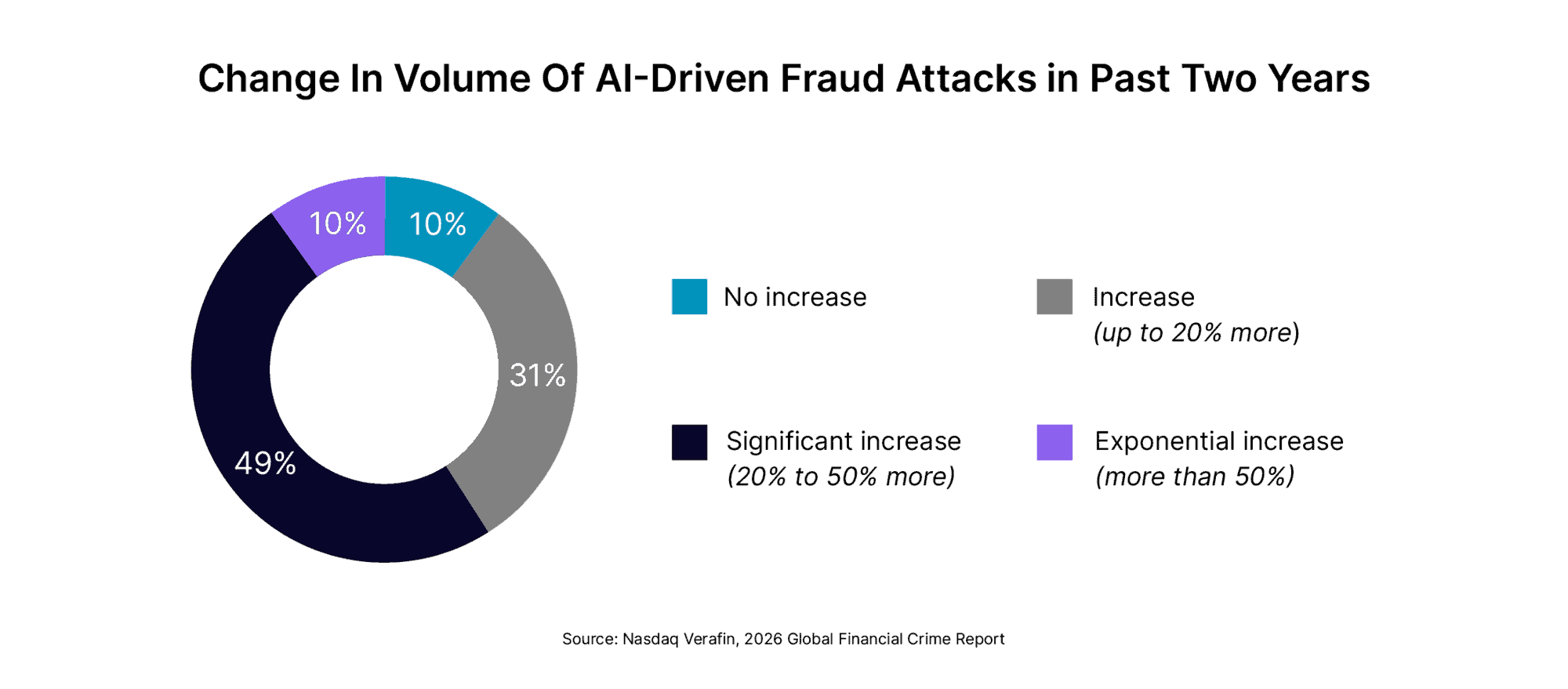
These shifts indicate a structural change in how criminals commit financial crime as they become more organized, connected, and technologically sophisticated. This shift has profound implications for the industry as legacy controls become less effective. To keep pace, the industry must move beyond fragmented solutions and adopt intelligence that can operate at the same speed and scale as modern crime.
AI represents a step change for financial crime management, not because it replaces human judgment, but because it allows institutions to efficiently scale operations to support business growth.
Stopping Criminal Networks Demands an AI-Led Industry Response
Modern financial crime rarely occurs in isolation. Fraud, money laundering, scams, and exploitation are increasingly interconnected, with criminals operating as networks rather than as lone actors. These networks exploit fragmentation between banks, across payment rails, and across borders. The 2026 Global Financial Crime Report highlights how criminals use mule networks and social engineering tactics across multiple institutions, often testing controls repeatedly until they find gaps.
With criminals increasingly operating within coordinated networks, siloed responses are no longer enough. The sheer volume and complexity of signals spread across customers, accounts, counterparties, channels, and institutions presents a unique challenge. AI helps institutions interpret this activity at a scale and speed that is not practical for human investigators or legacy models alone. By correlating cross-channel data and evolving signals over time, AI supports a more resilient response that adapts as criminal behavior changes, while still relying on human judgment to guide decisions.
Why Domain-Driven AI Makes the Difference
At Nasdaq Verafin, we continuously train our models on decades of real-world financial crime activity from our massive consortium dataset. We build AI models guided by input from financial crime investigators and compliance professionals learning from real cases, outcomes and constraints. Every model reflects lessons learned from how criminals operate and how financial institutions should respond.
Over time, this has created a powerful feedback loop. As threats evolve, our AI models evolve with them, informed by new typologies, new data and insights drawn from across our network. Domain expertise becomes embedded into technology. This domain-driven approach matters because accuracy, explainability, and trust are non‑negotiable in regulated environments. Financial institutions need AI they can understand, defend, and stand behind. Purpose-built AI models reflect how investigators actually work, how regulators evaluate decisions, and how criminals behave in practice. This foundation is what allows us to move confidently into the next era of AI.
Collective Action
The 2026 Global Financial Crime Report also highlights the growing necessity of collaboration as financial crime becomes increasingly networked. Criminals share intelligence freely within their networks, and the industry must respond with shared intelligence of its own that is responsible, secure, and aligned with established regulatory frameworks.
AI is most effective when it operates with the richest possible context to inform decisions, and in financial crime that context cannot come from any single institution alone. A consortium‑driven approach, where banks contribute data into a shared intelligence network, provides a broader and more meaningful view of how criminals operate across institutions, channels, and borders. Applied at scale, this shared intelligence allows AI to surface risk signals earlier, validate suspicions faster, and interpret activity in its full context. Over time, these network effects strengthen both individual institutions and the wider financial crime‑fighting ecosystem, making collective intelligence increasingly essential as crime continues to cross institutions, sectors, and geographic boundaries.
From Managing Workflows to Delivering Outcomes
Nasdaq Verafin’s report highlights the operational pressure facing financial institutions. Alert volumes continue to rise, while compliance teams are asked to manage greater complexity with limited resources. Agentic AI represents the next evolution of automation.
Agentic AI allows institutions to move from reactive management to proactive prevention. Rather than supporting individual steps in a workflow, agentic workers can complete end‑to‑end tasks, from research to decision support, within defined guardrails and aided by human oversight. This allows skilled investigators to focus on high-risk cases while AI handles repetitive, high‑volume activity.
Innovation only matters if institutions can trust, defend, and stand behind it with regulators. AI in regulated environments must be explainable, governed, and exam-ready. When built with governance at its core with clear audit trails, policy‑based controls, and human‑in‑the‑loop oversight, AI enables institutions to innovate with confidence, even as regulatory expectations continue to evolve.
Continuous Innovation Is the Real Advantage
The 2026 Global Financial Crime Report underscores that criminals will continue to evolve, adopting new tools, exploiting emerging payment rails, and relentlessly seeking out weaknesses across the financial system. Continuous innovation is a prerequisite for staying ahead of increasingly coordinated and technology‑enabled criminal networks. For the industry, this means treating AI as a long‑term strategic capability, committing to shared intelligence, and investing in systems that can learn and adapt as threats evolve.
The call to action within the 2026 Global Financial Crime Report is clear. Criminals are moving faster, using smarter tools, and operating without borders. Meeting that challenge requires a step change in how the industry thinks about intelligence, collaboration, and scale. AI, grounded in domain expertise and strengthened by shared intelligence, is foundational to protecting the integrity of the financial system.
About the Author:

ROB NORRIS
Senior Vice President, Head of Product Strategy, Nasdaq Verafin
With more than 16 years of experience at Nasdaq Verafin, Rob brings a wealth of knowledge and experience to his leadership role spearheading Nasdaq Verafin’s product management vision and strategic priorities. He has also excelled in numerous other senior roles across the company, including Director of Product Management and Director of Customer Success. An industry expert with a deep understanding of emerging technology and financial crime trends, Rob is passionate about working with teams of engineers, designers, and product managers to solve real problems for Nasdaq Verafin’s customers.